We finished up our month of studying plants. The boys are very excited to be moving on to insects next.
Devotional: We talked about Bhagavad Gita 10.26 when Krishna says "Of all trees I am the banyan tree" and Bhagavad Gita 15.1-4 about the banyan tree. We also decorated the banyan tree in our yard with some nearby flowers.
Language Arts: We're halfway through Primary Phonics workbook 4. Govinda did pages 24-40. It covered some new stuff like words ending with 'le' like apple and compound words like chipmunk and pineapple. We reviewed 'th' and 'wh' and practiced differentiating similar words like tree and three and can and candle. I'm looking forward to starting r-controlled vowels next! I think he's ready for this new stuff now that the long/short vowel practice has been going on for a while. There are readers that go along with this workbook that I haven't gotten yet but may get soon since they look nice.
Math: We're doing well with Math Mammoth 1B on place value, practicing with tens and ones. He did pages 4-27. We also played with place value number and picture cards, and those really help get an idea of the difference between ones, tens, hundreds, and thousands. If we keep doing a page everyday, we will be done in 3 months.
Science: We read more library books about trees and drew some in our book. Govinda really likes the redwoods, so we got some extra books about them and he made one out paper for his lego men to climb. We reviewed all about plants and trees and stapled our plant book together. On to insects we go in our Creation study!
Last but not least is the wonderful news that I have been blessed with a new computer, which means I will be able to share more pictures soon. Thank you everyone for your love and support!
Showing posts with label Science. Show all posts
Showing posts with label Science. Show all posts
Wednesday, April 6, 2011

Sunday, March 27, 2011
Flower-bearing Spring
Devotional: This week’s devotional was Bhagavad Gita 10.35 with Krishna saying “Of seasons, I am flower-bearing spring.” We talked about spring and the equinox and read stories about spring and flowers.
Language Arts: We’re really liking Primary Phonics. Workbook 4 is getting to be more challenging and still fun. He did up to page 24 this week, focusing on words ending with ank, ink, onk, unk, and ing. He really loves cursive, it seems to be more natural for him than printing.
Math: We had 7 more planned days with subtraction, but he kept saying it was too easy and wanted to move on. I said he could if he took the chapter test and got at least 20 out of 25 answers correct. He eagerly took the test and got 100%! One was originally wrong until he double checked it and found the mistake himself and corrected it. I guess subtraction is easy after spending so much time on addition! So, this week we finished up pages 82-84 of MM 1A. plus the test. Then we did the first 3 pages from MM 1B introducing place value and numbers to 100. We like this math program a lot. He’s having a lot of ‘a-ha’ moments with it.
Science: We added more to our plant book about local Hawaiian plants and their uses. We drew lots of flowers, including a 4 foot sunflower on the chalkboard. We labeled the parts of a tree and read about the rubber tree. Next week we will be finishing up our plant book and our month block of learning about plants.
Lots of love and gratitude to you all! :)
Language Arts: We’re really liking Primary Phonics. Workbook 4 is getting to be more challenging and still fun. He did up to page 24 this week, focusing on words ending with ank, ink, onk, unk, and ing. He really loves cursive, it seems to be more natural for him than printing.
Math: We had 7 more planned days with subtraction, but he kept saying it was too easy and wanted to move on. I said he could if he took the chapter test and got at least 20 out of 25 answers correct. He eagerly took the test and got 100%! One was originally wrong until he double checked it and found the mistake himself and corrected it. I guess subtraction is easy after spending so much time on addition! So, this week we finished up pages 82-84 of MM 1A. plus the test. Then we did the first 3 pages from MM 1B introducing place value and numbers to 100. We like this math program a lot. He’s having a lot of ‘a-ha’ moments with it.
Science: We added more to our plant book about local Hawaiian plants and their uses. We drew lots of flowers, including a 4 foot sunflower on the chalkboard. We labeled the parts of a tree and read about the rubber tree. Next week we will be finishing up our plant book and our month block of learning about plants.
Lots of love and gratitude to you all! :)
Sunday, March 13, 2011
Flowers and Fruits


Devotional: We continued memorizing Bhagavad Gita 9.26 "If one offers Me with love and devotion a leaf, a flower, fruit or water, I will accept it."
Science: We created flowers, leaves, roots, and sepals out of paper, the pistil and stamens out of pipe cleaners (we could only fit two), and the stem out of a straw to help remember the names of the parts of flowering plants. We drew and labeled the parts of a flower with a sliding piece of paper that reveals a pollen tube going down to the ovule. We colored and read about a different Hawai'ian plants and added them to our plant book. We read lots of great books about flowers, fruits, and gardens. How Groundhog's Garden Grew has been a favorite. We planted some seeds in the garden and weeded, too. Some beautiful plant drawings were also added to the plant book.
Language Arts: We started the next level of Primary Phonics workbook 4. We decided to skip workbook 3 because he didn't need that much review, and the new concepts he is already familiar with. So, pages 1-7 were completed. They focused on 'sh' and 'ch', which was review and good handwriting practice. This book gets into R controlled vowels later on, so it will soon be new, hard stuff, but he is ready for it. Govinda really wants to learn cursive, so I've been showing him the cursive letters on the chalkboard. Today, he wrote in his PP book with cursive! He likes how he knows where the letter starts...at the bottom, and it's fun how it keeps flowing without having to pick up the pencil. For reading, he's been practicing with Bob Books.
Math: He did Math Mammoth pages 73-82, which was more subtraction practice with fact families and their addition twins. He's really getting the facts down with the constant practice...no flashcards needed! He doesn't need to look at the abacus for most facts up to 10. He's been expressing his interest in place value and big numbers, so I'm looking forward to doing that as soon as we're done with subtraction in a week or two.
Thanks to all who care to read all of this! Infinite love and gratitude for you all! :)
Friday, March 11, 2011
Seeds, Roots, Shoots, and Leaves!
Devotional: We wrote on the board Bhagavad Gita 9.26 "If one offers Me with love and devotion a leaf, a flower, fruit or water, I will accept it." We added leaves, flowers, and fruits around the border and discussed the verse. We read the story of the sacred Tulasi plant from the book we own called Beauty, Power, and Grace The Many Faces Of The Goddess.
Science: We're adding more to the Plant book everyday. We've drawn and labeled the parts of a seed, plant, and flower. We're watching celery stalks soak up water with red food coloring and drawing it. We've gathered leaves and made many leaf rubbings with block crayons. We've been reading about a different plant everyday and recording it's uses and other important things to know about it. We used Kukui nut (Candlenut) juice to mend a cut (after reading about it). We gathered Kukui nuts, which are 50% oil, and polished our wooden toys with it. Of course we read many library books about plants and how they grow. One library book called Plants Of Old Hawaii has been great with its catchy poems full of information on plants along with a black and white picture which I copy for the boys to color while I read about it.
Language Arts: This week Govinda finished the whole Primary Phonics workbook! It's a great feeling. He had fun looking back through the 80 pages of 40+ days worth of drawing, coloring, and writing work. These past two weeks, he did pages 57-80. He can easily read many long vowel words now. PP helped distinguish the difference between them.
Math: Govinda did Math Mammoth pages 60-72. Subtraction is really going well for him now. Math Mammoth may seem like ordinary workbook pages, but there's something really special about it that is making math really make sense. It makes him think for himself more than any other math program we've tried, which is working well for him.
This week we spent some time remembering our studies of Japan and sent prayers for everyone there for the 8.8 earthquake and tsunami. We discussed survival skills and the history of earthquakes and tsunamis.
Science: We're adding more to the Plant book everyday. We've drawn and labeled the parts of a seed, plant, and flower. We're watching celery stalks soak up water with red food coloring and drawing it. We've gathered leaves and made many leaf rubbings with block crayons. We've been reading about a different plant everyday and recording it's uses and other important things to know about it. We used Kukui nut (Candlenut) juice to mend a cut (after reading about it). We gathered Kukui nuts, which are 50% oil, and polished our wooden toys with it. Of course we read many library books about plants and how they grow. One library book called Plants Of Old Hawaii has been great with its catchy poems full of information on plants along with a black and white picture which I copy for the boys to color while I read about it.
Language Arts: This week Govinda finished the whole Primary Phonics workbook! It's a great feeling. He had fun looking back through the 80 pages of 40+ days worth of drawing, coloring, and writing work. These past two weeks, he did pages 57-80. He can easily read many long vowel words now. PP helped distinguish the difference between them.
Math: Govinda did Math Mammoth pages 60-72. Subtraction is really going well for him now. Math Mammoth may seem like ordinary workbook pages, but there's something really special about it that is making math really make sense. It makes him think for himself more than any other math program we've tried, which is working well for him.
This week we spent some time remembering our studies of Japan and sent prayers for everyone there for the 8.8 earthquake and tsunami. We discussed survival skills and the history of earthquakes and tsunamis.
Monday, February 28, 2011
Intro To Plants
Devotional: We wrote on the devotional chalkboard Bhagavad Gita 14.4 when Krishna says "It should be understood that all species of life are made possible by birth in this material nature, and that I am the seed-giving father." We drew plants growing from seeds around as the border.
Science: This past week gently introduced our coming study vegetation with story books. Oh Say Can You Seed, Magic School Bus Plants Seeds, and The Lorax are their favorites so far. Govinda drew and labeled the parts of a plant for the main lesson book. We also found all of the seeds in the kitchen and put them in a glass with wet paper towels keeping them against the glass to easily watch them grow. We found mung beans, lentils, mustard seeds, coriander seeds, cumin seeds, popcorn, wheat berries, rice, quinoa, millet, lemon seed, tangerine seed, and a cherry seed. The mung beans, mustard seeds, and wheat berries were the first to sprout. We discussed all the uses we have for plants and how important they are for life.
Language Arts: Primary Phonics is becoming more well loved every day! Govinda did pages 46-56, which focused on reviewing silent e words, 'oa', 'ai', and the long e sound spelled 'ea'. The highlight was a funny creation he calls 'pail man', a transformed picture of a pail in which Govinda adds a face to the book's drawing of a pail and draws a body, arms, and legs, sometimes upside down standing on his hands. I'm glad he's having fun writing 15+ spelling words every day to match the pictures. Primary Phonics is proving to be much more fun than spelling tests!
Math: This week Govinda finished chapter 1 on addition and took the test. He originally got 2 wrong, and when I asked him to double check, he corrected them. So, he scored a 91% or 100%, which is a good sign of success! We then started chapter 2 on subtraction and did pages 58-60. I was happy to hear him say 'subtraction is easy'! Since we worked so much on understanding the math facts as a whole and parts, he has realized that subtraction is the same as finding the missing part. This is a relief because when we were using CLE math back in fall, he hit a wall when we got to subtraction. I am seeing the benefits with the Asian method of understanding math compared to the American style of memorizing. Math Mammoth is a keeper for us!
Thanks to all of our well wishers for caring to read about our adventures in learning. Take care and God Bless!
Science: This past week gently introduced our coming study vegetation with story books. Oh Say Can You Seed, Magic School Bus Plants Seeds, and The Lorax are their favorites so far. Govinda drew and labeled the parts of a plant for the main lesson book. We also found all of the seeds in the kitchen and put them in a glass with wet paper towels keeping them against the glass to easily watch them grow. We found mung beans, lentils, mustard seeds, coriander seeds, cumin seeds, popcorn, wheat berries, rice, quinoa, millet, lemon seed, tangerine seed, and a cherry seed. The mung beans, mustard seeds, and wheat berries were the first to sprout. We discussed all the uses we have for plants and how important they are for life.
Language Arts: Primary Phonics is becoming more well loved every day! Govinda did pages 46-56, which focused on reviewing silent e words, 'oa', 'ai', and the long e sound spelled 'ea'. The highlight was a funny creation he calls 'pail man', a transformed picture of a pail in which Govinda adds a face to the book's drawing of a pail and draws a body, arms, and legs, sometimes upside down standing on his hands. I'm glad he's having fun writing 15+ spelling words every day to match the pictures. Primary Phonics is proving to be much more fun than spelling tests!
Math: This week Govinda finished chapter 1 on addition and took the test. He originally got 2 wrong, and when I asked him to double check, he corrected them. So, he scored a 91% or 100%, which is a good sign of success! We then started chapter 2 on subtraction and did pages 58-60. I was happy to hear him say 'subtraction is easy'! Since we worked so much on understanding the math facts as a whole and parts, he has realized that subtraction is the same as finding the missing part. This is a relief because when we were using CLE math back in fall, he hit a wall when we got to subtraction. I am seeing the benefits with the Asian method of understanding math compared to the American style of memorizing. Math Mammoth is a keeper for us!
Thanks to all of our well wishers for caring to read about our adventures in learning. Take care and God Bless!
Thursday, February 24, 2011
Vegetation Book List
Antonio's rain forest by Lewington, Anna.
Banyan Drive : the stories of incredible people by Coombs, Ted.
The giving tree by Silverstein, Shel.
Grasses and grains by Greenaway, Theresa, 1947-
Grow, little one, grow! by Brigoli, Joy.
In the heart of the village : the world of the Indian Banyan tree by Bash, Barbara.
Janice VanCleave's plants : mind-boggling experiments you can turn into science fair projects. by VanCleave, Janice Pratt.
Leaves! Leaves! Leaves! by Wallace, Nancy Elizabeth.
The life cycle of a pine tree by Tagliaferro, Linda.
The Lorax by Seuss, Dr.
Plants of old Hawaii by Lucas, Lois.
Scholastic's The magic school bus plants seeds : a book about how living things grow by Relf, Patricia.
Spring is here! : a story about seeds by Holub, Joan.
The surprise garden by Hall, Zoe, 1957-
To be like the sun by Swanson, Susan Marie.
Why do leaves change color by Maestro, Betsy.
Oh say can you seed? by Worth, Bonnie.
Acorn to oak tree by Owen, Oliver S., 1920-
Coat of the earth; the story of grass by HEADY, ELEANOR B.
Fables beneath the rainbow by Hayashi, Leslie Ann.
Fables from the garden by Hayashi, Leslie Ann.
A fruit is a suitcase for seeds by Richards, Jean, 1940-
I can name 50 trees today! by Worth, Bonnie.
I'm a seed /by Marzollo, Jean.
Lily's garden of India by Smith, Jeremy, 1974-
Plant packages : a book about seeds by Blackaby, Susan.
Plants and animals of Hawai'i by Scott, Susan, 1948-
Science with plants by Unwin, Mike.
Seeds! Seeds! Seeds! by Wallace, Nancy Elizabeth.
The tiny seed by Carle, Eric.
Banyan Drive : the stories of incredible people by Coombs, Ted.
The giving tree by Silverstein, Shel.
Grasses and grains by Greenaway, Theresa, 1947-
Grow, little one, grow! by Brigoli, Joy.
In the heart of the village : the world of the Indian Banyan tree by Bash, Barbara.
Janice VanCleave's plants : mind-boggling experiments you can turn into science fair projects. by VanCleave, Janice Pratt.
Leaves! Leaves! Leaves! by Wallace, Nancy Elizabeth.
The life cycle of a pine tree by Tagliaferro, Linda.
The Lorax by Seuss, Dr.
Plants of old Hawaii by Lucas, Lois.
Scholastic's The magic school bus plants seeds : a book about how living things grow by Relf, Patricia.
Spring is here! : a story about seeds by Holub, Joan.
The surprise garden by Hall, Zoe, 1957-
To be like the sun by Swanson, Susan Marie.
Why do leaves change color by Maestro, Betsy.
Oh say can you seed? by Worth, Bonnie.
Acorn to oak tree by Owen, Oliver S., 1920-
Coat of the earth; the story of grass by HEADY, ELEANOR B.
Fables beneath the rainbow by Hayashi, Leslie Ann.
Fables from the garden by Hayashi, Leslie Ann.
A fruit is a suitcase for seeds by Richards, Jean, 1940-
I can name 50 trees today! by Worth, Bonnie.
I'm a seed /by Marzollo, Jean.
Lily's garden of India by Smith, Jeremy, 1974-
Plant packages : a book about seeds by Blackaby, Susan.
Plants and animals of Hawai'i by Scott, Susan, 1948-
Science with plants by Unwin, Mike.
Seeds! Seeds! Seeds! by Wallace, Nancy Elizabeth.
The tiny seed by Carle, Eric.
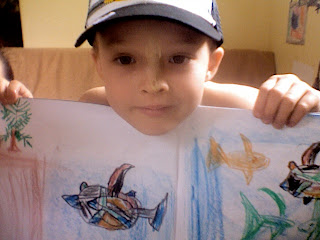
Aquatics Book Art
Here's a picture of Govinda's artwork from the Aquatics Book he made. One picture is of an ocean scene with whales and sharks and other small fish. The other picture is the Hawaii state fish, the Humuhumunukunukuapua'a. He looked at a picture of one and carefully drew the design and colors.



Monday, February 21, 2011
Not Truly Fish
Devotional: We reviewed the story of Matsya and all other related verses to our study of aquatics.
Science: This past week was dedicated to starfish, jelly fish, and shellfish, which are not truly fish. They are invertebrates and do not have backbones, gills, and fins like true fish. Construction paper is always available for spontaneous arts and crafts, and Govinda made a jellyfish and octopus to add to his box of paper fish. I gotta get some pictures of these soon, they're works of art! We finished up the Aquatics main lesson book and it turned out really nice. He also drew a nice picture of these invertebrates for the main lesson book.
Language Arts: Primary Phonics pages 31-45 were completed. He really likes these books and sometimes does more than the 2 pages per day that I require. It's like a phonics and spelling workbook disguised as a fun and silly coloring book. It's all review for him, but the practice is really building his confidence. These pages were focused on silent e words and the vowel teams 'ie', 'oe', and 'oa'. We also did a few lessons from The Ordinary Parent's Guide To Teaching Reading, as we are just filling in the gaps to skip ahead to where I think his reading level is at. His reading level is way beyond his spelling level, and I'm considering reading the highest priority at his age and we'll get more serious about spelling in the years to come. Govinda is surprising me everyday by leaps and bounds by his sudden advancement in reading abilities. I'm planning on using OPGTR to eventually take him to a 4th grade level. He likes the tongue twister poems and silly stories better than controlled readers. Both the boys crack up from one poem story that says "the tank sank...yank the tank!"
Math: Math Mammoth pages 47-53. These pages were very full, but he was able to finish each one in one sitting. Each page focused on reviewing sums of 6, 7, 8, 9, and 10. Next will be the Chapter 1 test on addition, but I'm going to give it to him as another worksheet without calling it a test, but still observing how he does completely on his own. The constant practice and review of math facts is really helping him get familiar with them. He's even doing math for fun with sidewalk chalk and it seems he is thinking mathematically on his own. He likes MM and wants to keep going with it! The next chapter is onto subtraction!
I'm preparing for our next Creation science study on Vegetation and it looks like fun! :)
Science: This past week was dedicated to starfish, jelly fish, and shellfish, which are not truly fish. They are invertebrates and do not have backbones, gills, and fins like true fish. Construction paper is always available for spontaneous arts and crafts, and Govinda made a jellyfish and octopus to add to his box of paper fish. I gotta get some pictures of these soon, they're works of art! We finished up the Aquatics main lesson book and it turned out really nice. He also drew a nice picture of these invertebrates for the main lesson book.
Language Arts: Primary Phonics pages 31-45 were completed. He really likes these books and sometimes does more than the 2 pages per day that I require. It's like a phonics and spelling workbook disguised as a fun and silly coloring book. It's all review for him, but the practice is really building his confidence. These pages were focused on silent e words and the vowel teams 'ie', 'oe', and 'oa'. We also did a few lessons from The Ordinary Parent's Guide To Teaching Reading, as we are just filling in the gaps to skip ahead to where I think his reading level is at. His reading level is way beyond his spelling level, and I'm considering reading the highest priority at his age and we'll get more serious about spelling in the years to come. Govinda is surprising me everyday by leaps and bounds by his sudden advancement in reading abilities. I'm planning on using OPGTR to eventually take him to a 4th grade level. He likes the tongue twister poems and silly stories better than controlled readers. Both the boys crack up from one poem story that says "the tank sank...yank the tank!"
Math: Math Mammoth pages 47-53. These pages were very full, but he was able to finish each one in one sitting. Each page focused on reviewing sums of 6, 7, 8, 9, and 10. Next will be the Chapter 1 test on addition, but I'm going to give it to him as another worksheet without calling it a test, but still observing how he does completely on his own. The constant practice and review of math facts is really helping him get familiar with them. He's even doing math for fun with sidewalk chalk and it seems he is thinking mathematically on his own. He likes MM and wants to keep going with it! The next chapter is onto subtraction!
I'm preparing for our next Creation science study on Vegetation and it looks like fun! :)
Saturday, February 12, 2011
Whales and Dolphins
Devotional: "Krishna is an ocean of mercy" was on the chalkboard and the boys had fun drawing more waves and fish around it. We discussed what mercy and grace are. We also talked about Bhagavad Gita 10.24 when Krishna says "of bodies of water, I am the ocean".
Science: We read a lot of books about whales and dolphins. We saw humpback whales at the beach (thanks to the Lord for that perfect field trip). We compared baleen and toothed whales as well as the different sizes of different kinds of whales. We added a ven diagram to the book comparing the similarities and difference between fish and whales. We pondered how amazing it is that the Blue Whale is the largest animal in the world and lives off of some of the smallest animals in the world. The history of whaling was sad to learn, so we are so thankful that it has stopped. We will spend one more week finishing up our Aquatics main lesson book and will next move on to vegetation, as we continue with our Creation science study.
Language Arts: Primary Phonics pages 15-30 were completed, reviewing more silent e words with long a, long i, and long o. He surprised me by reading a very advanced library book, and it seems that more decoding skills have taken a leap!
Math: Math Mammoth pages 40-47 were completed, which focused on sums of 9 and 10 and review of greater than/less than and adding on a number line. Daily practice of math facts is starting to sink in! Next week we'll be done with this chapter on addition and will take a test and then move on to subtraction!
Science: We read a lot of books about whales and dolphins. We saw humpback whales at the beach (thanks to the Lord for that perfect field trip). We compared baleen and toothed whales as well as the different sizes of different kinds of whales. We added a ven diagram to the book comparing the similarities and difference between fish and whales. We pondered how amazing it is that the Blue Whale is the largest animal in the world and lives off of some of the smallest animals in the world. The history of whaling was sad to learn, so we are so thankful that it has stopped. We will spend one more week finishing up our Aquatics main lesson book and will next move on to vegetation, as we continue with our Creation science study.
Language Arts: Primary Phonics pages 15-30 were completed, reviewing more silent e words with long a, long i, and long o. He surprised me by reading a very advanced library book, and it seems that more decoding skills have taken a leap!
Math: Math Mammoth pages 40-47 were completed, which focused on sums of 9 and 10 and review of greater than/less than and adding on a number line. Daily practice of math facts is starting to sink in! Next week we'll be done with this chapter on addition and will take a test and then move on to subtraction!
Wednesday, February 2, 2011
Matsya, Fish, and the Food Chain
We continued with our aquatics block with a study based on the story of Matsya from the Srimad Bhagavatam 8.24.
Devotional: 'Krishna is an ocean of mercy!' We wrote this on the devotional chalk board and drew lots of waves on the ocean of mercy.
Science: We read the story of Matsya several times, which taught the places where fish live...pots/bowls/aquariums, rivers and streams, lakes and ponds, and the ocean. Govinda drew a picture for each in the main lesson book. The Matsya story also taught about the aquatic food chain, which he drew. We discussed and drew how fish protect themselves. We read many library books about fish and how they live and drew many different kinds. The whale shark is the biggest fish and had a few special drawings in the book along with many sharks. Especially fun was the Hawaii state fish, the Humuhumunukunukuapua'a.
Language Arts: Govinda did 8 pages of Primary Phonics workbook 2 which practiced 'long i' words with silent e.
Math: He did 4 action packed Math Mammoth pages focused on sums of 8. Greater than/less than was reviewed.
Devotional: 'Krishna is an ocean of mercy!' We wrote this on the devotional chalk board and drew lots of waves on the ocean of mercy.
Science: We read the story of Matsya several times, which taught the places where fish live...pots/bowls/aquariums, rivers and streams, lakes and ponds, and the ocean. Govinda drew a picture for each in the main lesson book. The Matsya story also taught about the aquatic food chain, which he drew. We discussed and drew how fish protect themselves. We read many library books about fish and how they live and drew many different kinds. The whale shark is the biggest fish and had a few special drawings in the book along with many sharks. Especially fun was the Hawaii state fish, the Humuhumunukunukuapua'a.
Language Arts: Govinda did 8 pages of Primary Phonics workbook 2 which practiced 'long i' words with silent e.
Math: He did 4 action packed Math Mammoth pages focused on sums of 8. Greater than/less than was reviewed.
Water Cycle
We started our aquatics block with the water cycle, based on the Creation book.
Devotional: Krishna is the taste of water! We wrote this on our devotional chalkboard and the boys drew rain, rivers, and ocean, and a glass of water. This is based on the Bhagavad Gita verse 7.8, which we discussed and reviewed.
Science: Govinda drew a beautiful drawing of the water cycle for the aqautics main lesson book. We learned this song to the tune of 'She'll Be Coming 'Round The Mountain':
Water travels in a cycle, yes it does! Water travels in a cycle, yes it does!
It goes up as evaporation, forms clouds as condensation, and falls as precipitation!
Language Arts: We stopped ETC3 and switched to Primary Phonics, which he likes much better. They're by the same publisher, but the drawings in PP are much nicer and in the mode of goodness. Even I didn't like the drawing on the cover of ETC3 and had to cover it up (it shows a picture for mad and made). PP is what Montessori schools use. It's like a good coloring book, and he enjoys coloring the pictures and writing the matching words. We may try some of the readers that go with it. He's gone through 8 pages covering 'long a' words with silent e. It's all review, but very needed to master those silent e words.
Math: We've been working our way through Math Mammoth and has completed 12 action packed pages since I last posted about math. We're working on mastering sums of 5, 6, and 7. He's catching on quickly and can do more in one sitting now. MM is working well and Rightstart isn't realistically happening at all. The RS abacus it essential for him to do MM, and he is starting to see the abacus in his mind.
Devotional: Krishna is the taste of water! We wrote this on our devotional chalkboard and the boys drew rain, rivers, and ocean, and a glass of water. This is based on the Bhagavad Gita verse 7.8, which we discussed and reviewed.
Science: Govinda drew a beautiful drawing of the water cycle for the aqautics main lesson book. We learned this song to the tune of 'She'll Be Coming 'Round The Mountain':
Water travels in a cycle, yes it does! Water travels in a cycle, yes it does!
It goes up as evaporation, forms clouds as condensation, and falls as precipitation!
Language Arts: We stopped ETC3 and switched to Primary Phonics, which he likes much better. They're by the same publisher, but the drawings in PP are much nicer and in the mode of goodness. Even I didn't like the drawing on the cover of ETC3 and had to cover it up (it shows a picture for mad and made). PP is what Montessori schools use. It's like a good coloring book, and he enjoys coloring the pictures and writing the matching words. We may try some of the readers that go with it. He's gone through 8 pages covering 'long a' words with silent e. It's all review, but very needed to master those silent e words.
Math: We've been working our way through Math Mammoth and has completed 12 action packed pages since I last posted about math. We're working on mastering sums of 5, 6, and 7. He's catching on quickly and can do more in one sitting now. MM is working well and Rightstart isn't realistically happening at all. The RS abacus it essential for him to do MM, and he is starting to see the abacus in his mind.
Thursday, January 27, 2011
Aquatics Book List
Aquatics Book List (water, ocean, fish, and marine mammals):
About fish : a guide for children by Sill, Cathryn P.
Across the big blue sea : an ocean wildlife book by Wood, Jakki.
Amazing whales! by Thomson, Sarah L.
Baby whale rescue : the true story of J.J. by Arnold, Caroline.
Baby whales drink milk by Esbensen, Barbara Juster.
Blue sea by Kalan, Robert.
By the ocean : learning the long O sound by Richter, Abigail, 1971-
I wonder why the sea is salty and other questions about the oceans by Ganeri, Anita, 1961-
The magic school bus on the ocean floor by Cole, Joanna.
The rainbow fish by Pfister, Marcus.
What's it like to be a fish? by Pfeffer, Wendy
Amazing dolphins! by Thomson, Sarah L.
Curious clownfish by Maddern, Eric.
Dolphins and sharks : a nonfiction companion to Dolphins at daybreak by Osborne, Mary Pope.
Dolphins at daybreak by Osborne, Mary Pope.
Dolphins! by Behrens, June.
Fidgety fish and friends by Bright, Paul,
Fish, fish, fish by Adams, Georgie.
Follow the water from brook to ocean by Dorros, Arthur.
Hidden under the sea : the world beneath the waves by Kent, Peter, 1949-
I can read about whales and dolphins by Anderson, J. I.
Janice VanCleave's oceans for every kid : easy activities that make learning science fun. by VanCleave, Janice Pratt.
Mysteries of the ocean deep by Dipper, Frances, 1951-
Ocean friends by Nelson, Robert Lyn, 1955-
One fish, two fish, red fish, blue fish by Seuss, Dr.
Sammy, the seal by Hoff, Syd, 1912-2004.
SWIMMY by Lionni, Leo, 1910-1999.
Whales : the gentle giants by Milton, Joyce.
Winter whale by Ryder, Joanne.
Awesome ocean science! : investigating the secrets of the underwater world by Littlefield, Cindy A., 1956-
Clam-I-am! by Rabe, Tish.
Exploring the ocean depths : the final frontier by Jedicke, Peter.
Fabulous fishes by Stockdale, Susan.
Fish is fish by Lionni, Leo,
A fish out of water by Palmer, Helen Marion, 1898-
I get wet by Cobb, Vicki.
Let's try it out in the water : hands-on early-learning science activities by Simon, Seymour.
The magic school bus at the waterworks by Cole, Joanna.
Oceans & art activities. by Sacks, Janet.
*Splish splash by Weeks, Sarah.
Aquatics Verses:
Bhagavad Gita: 2.70, 7.8, 9.26, 10.31
Srimad Bhagavatam: 5.18.13, 6.6.26, 8.24
Water Cycle Song:
Water travels in a cycle, yes it does!
Water travels in a cycle, yes it does!
It goes up as evaporation,
Forms clouds as condensation,
And falls as precipitation!
About fish : a guide for children by Sill, Cathryn P.
Across the big blue sea : an ocean wildlife book by Wood, Jakki.
Amazing whales! by Thomson, Sarah L.
Baby whale rescue : the true story of J.J. by Arnold, Caroline.
Baby whales drink milk by Esbensen, Barbara Juster.
Blue sea by Kalan, Robert.
By the ocean : learning the long O sound by Richter, Abigail, 1971-
I wonder why the sea is salty and other questions about the oceans by Ganeri, Anita, 1961-
The magic school bus on the ocean floor by Cole, Joanna.
The rainbow fish by Pfister, Marcus.
What's it like to be a fish? by Pfeffer, Wendy
Amazing dolphins! by Thomson, Sarah L.
Curious clownfish by Maddern, Eric.
Dolphins and sharks : a nonfiction companion to Dolphins at daybreak by Osborne, Mary Pope.
Dolphins at daybreak by Osborne, Mary Pope.
Dolphins! by Behrens, June.
Fidgety fish and friends by Bright, Paul,
Fish, fish, fish by Adams, Georgie.
Follow the water from brook to ocean by Dorros, Arthur.
Hidden under the sea : the world beneath the waves by Kent, Peter, 1949-
I can read about whales and dolphins by Anderson, J. I.
Janice VanCleave's oceans for every kid : easy activities that make learning science fun. by VanCleave, Janice Pratt.
Mysteries of the ocean deep by Dipper, Frances, 1951-
Ocean friends by Nelson, Robert Lyn, 1955-
One fish, two fish, red fish, blue fish by Seuss, Dr.
Sammy, the seal by Hoff, Syd, 1912-2004.
SWIMMY by Lionni, Leo, 1910-1999.
Whales : the gentle giants by Milton, Joyce.
Winter whale by Ryder, Joanne.
Awesome ocean science! : investigating the secrets of the underwater world by Littlefield, Cindy A., 1956-
Clam-I-am! by Rabe, Tish.
Exploring the ocean depths : the final frontier by Jedicke, Peter.
Fabulous fishes by Stockdale, Susan.
Fish is fish by Lionni, Leo,
A fish out of water by Palmer, Helen Marion, 1898-
I get wet by Cobb, Vicki.
Let's try it out in the water : hands-on early-learning science activities by Simon, Seymour.
The magic school bus at the waterworks by Cole, Joanna.
Oceans & art activities. by Sacks, Janet.
*Splish splash by Weeks, Sarah.
Aquatics Verses:
Bhagavad Gita: 2.70, 7.8, 9.26, 10.31
Srimad Bhagavatam: 5.18.13, 6.6.26, 8.24
Water Cycle Song:
Water travels in a cycle, yes it does!
Water travels in a cycle, yes it does!
It goes up as evaporation,
Forms clouds as condensation,
And falls as precipitation!
Friday, January 14, 2011
Time and Space
We've read a lot of books about the sun, moon, and planets. We made a model of the solar system that hangs from the ceiling above Govinda's bed. The fan blows them so the spin! We are making a book with drawings of each planet. We drew the wheel of the sun with the 12 months as the spokes and the seasons as the rim. We drew the days of the week as they are named after the closer planets. We drew the phases of the moon with white crayon on black paper. We read from scriptures about our universe and discussed the differences between Vedic cosmology and modern astronomy. We drew on the chalkboard the sun and moon and wrote "Krishna is the light of the sun and moon", based on Bhagavad Gita 7.8.
Space Booklist:
Another day in the Milky Way by Milgrim, David
Bear shadow by Asch, Frank
Blast off! : a space counting book by Cole, Norma
Dogs in space by Coffelt, Nancy
Happy birthday, moon by Asch, Frank
*The magic school bus, lost in the solar system by Cole, Joanna
Planets around the sun by Simon, Seymour
*Sun bread by Kleven, Elisa
The sun is always shining somewhere by Fowler, Allan.
Sun up, sun down by Gibbons, Gail
Sun up, sun down : the story of day and night by Bailey, Jacqui
The sun's day by Gerstein, Mordicai
The sun's family of planets by Fowler, Allan
Sunshine, moonshine by Armstrong, Jennifer
Thomas on the moon by Awdry, W. Railway series.
What the sun sees ; What the moon sees by Tafuri, Nancy
Who likes the sun? by Kaner, Etta
Hello sun! by Wilhelm, Hans
Me and my shadow by Dorros, Arthur
My light by Bang, Molly
Regards to the man in the moon by Keats, Ezra Jack
Under the sun by Kandoian, Ellen
Where does the sun go at night by Ginsburg, Mirra
Space Verses:
Bhagavad Gita: 4.1, 7.8, 8.16, 10.21, 11.20
Srimad Bhagavatam: 3.6.15, 3.11.14-15, 5.20.45-46, 5.21.13, 5.22.5, 11.19.
Brahma Samhita: 5.52
Space Booklist:
Another day in the Milky Way by Milgrim, David
Bear shadow by Asch, Frank
Blast off! : a space counting book by Cole, Norma
Dogs in space by Coffelt, Nancy
Happy birthday, moon by Asch, Frank
*The magic school bus, lost in the solar system by Cole, Joanna
Planets around the sun by Simon, Seymour
*Sun bread by Kleven, Elisa
The sun is always shining somewhere by Fowler, Allan.
Sun up, sun down by Gibbons, Gail
Sun up, sun down : the story of day and night by Bailey, Jacqui
The sun's day by Gerstein, Mordicai
The sun's family of planets by Fowler, Allan
Sunshine, moonshine by Armstrong, Jennifer
Thomas on the moon by Awdry, W. Railway series.
What the sun sees ; What the moon sees by Tafuri, Nancy
Who likes the sun? by Kaner, Etta
Hello sun! by Wilhelm, Hans
Me and my shadow by Dorros, Arthur
My light by Bang, Molly
Regards to the man in the moon by Keats, Ezra Jack
Under the sun by Kandoian, Ellen
Where does the sun go at night by Ginsburg, Mirra
Space Verses:
Bhagavad Gita: 4.1, 7.8, 8.16, 10.21, 11.20
Srimad Bhagavatam: 3.6.15, 3.11.14-15, 5.20.45-46, 5.21.13, 5.22.5, 11.19.
Brahma Samhita: 5.52
Creation Unit Study for 2011
We will be studying aspects of science with homemade unit studies based on a wonderful book about the Vedic creation story called Creation: A Story From Ancient India by Rasamandala Das and Ananta Shakti Das. The boys love this book and we have already read it several times. It summarizes stories from the Srimad Bhagavatam with beautiful pictures.

We will be spending a month on each of the different subjects:
January - Time and Space
February - Aquatics
March - Vegetation
April - Insects
May - Reptiles
June - Birds
July - Mammals
August - Human beings/body
We'll read library books, make our own books, and do science experiments and art projects. After a year of geography, science themes seem especially exciting!

We will be spending a month on each of the different subjects:
January - Time and Space
February - Aquatics
March - Vegetation
April - Insects
May - Reptiles
June - Birds
July - Mammals
August - Human beings/body
We'll read library books, make our own books, and do science experiments and art projects. After a year of geography, science themes seem especially exciting!
Subscribe to:
Posts (Atom)